

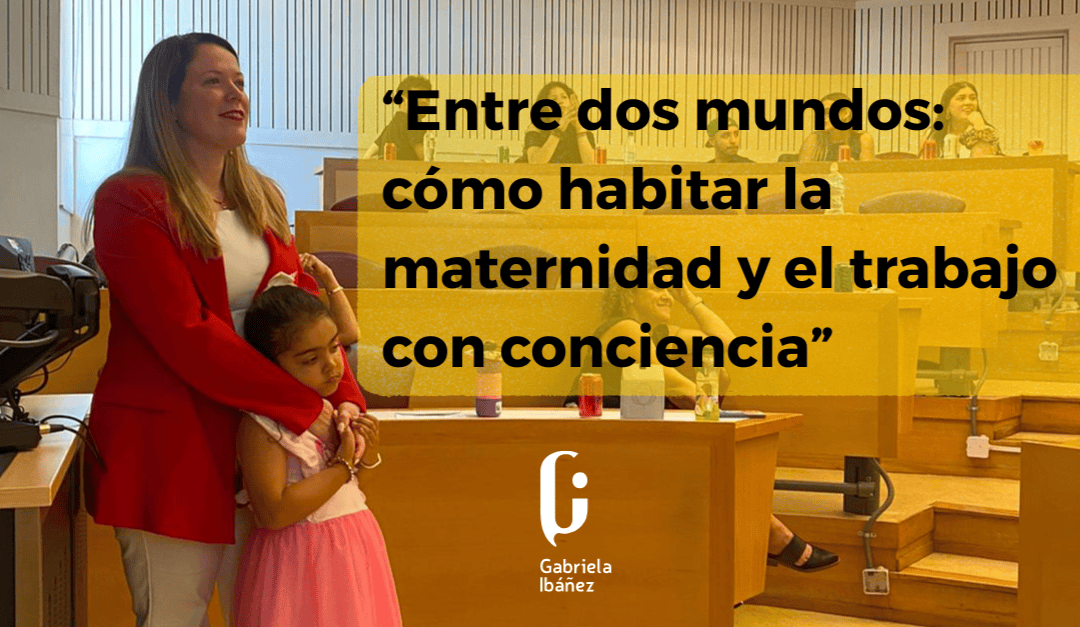
Conciliation is not balance. It is design.
A Reflection on Motherhood, Leadership, and Conscious Organizational Cultures
An article for Mother’s Day — and for all those who lead, care, and build at the same time.
Yesterday was Mother’s Day. And I want to speak to the mothers who lead organizations, teams, projects, and families all at once. But I also want to speak to the fathers who are learning to care. And above all, I want to speak to those who, from positions of power, have the possibility and the responsibility to change the rules of the game.
Because what many call “balance” is, in reality, a very well-dressed lie.
The Myth of Balance
Balance implies that there are two perfect pans on a scale, and that the work consists of not letting either one fall. It’s a metaphor that sounds reasonable, but in practice it demands that people — especially women — be two people at the same time, with the same energy, on the same day.
Conciliation is not balance. It is design.
Conscious design of priorities, of limits, of agreements, of structures. And like all good design, it requires intention, context, and, above all, the right conditions to execute. No architect designs on land that doesn’t belong to them, without tools, and with limited time. But that is exactly what we ask of millions of mothers who work every day.
The Numbers That Don’t Lie
The data is uncomfortable, but necessary for those who make decisions from the C-Suite.
In Latin America, the wage gap between mothers and fathers reaches 23.7%, while between people without children it is 15.9% — what economist Claudia Goldin called the Motherhood Penalty: the concrete penalty that motherhood imposes on women’s careers and income. This is not a talent problem. It is an organizational design problem.
The study Radiografía Mujeres en el Trabajo 2025 by Buk, with data from across the region, reveals that mothers face higher levels of exhaustion than women without children, and that 46% of women in leadership want to change jobs or are actively trying to. They are not being fired — they are leaving. Voluntarily. Because the environment is not designed for them.
And when the leaders themselves are asked, 33% of women in leadership positions perceive that men earn more in their organization, compared to only 20% of male leaders who share that perception. The same reality, read from two different places. The distance between those two readings is exactly the size of the problem.
A study by CIMAD at IPADE Business School found that mothers in leadership positions present significantly higher levels of burnout than fathers in the same positions, with greater exhaustion and depersonalization. Not because they are weaker. But because they carry more.
The Emotion No One Names in Board Meetings
There is a word that appears over and over in private conversations among women leaders, but almost never in strategic conversations within organizations: guilt.
Guilt when you’re at the office and your child has a fever. Guilt when you’re at home and haven’t answered emails. Guilt for asking for flexibility. Guilt for not asking for it and arriving late to pick them up. Guilt for having ambition. Guilt for wanting to stop.
This guilt is not a character flaw or a self-esteem problem. It is the direct consequence of living within structures that were designed for people without caregiving responsibilities; that is, historically, for men with partners at home. When those structures don’t change, the person absorbs the guilt. And the person, in this case, is the mother.
Added to this is the demand — an impossible standard that organizational and social culture simultaneously imposes: to be a present, loving, available mother; and to be a committed, productive, always-on leader. The discourse of multitasking: it didn’t necessarily liberate women; many times it ended up installing an impossible standard to sustain.
And then there are expectations — both our own and others’. The expectation that “you can have it all,” that “those who want to, can,” that conditions are an excuse and not a real variable. This narrative individualizes what is structural, and turns into a personal failure what is a systemic failure.
Naming these emotions is not complaining. It is intellectual honesty. And the leaders who have that honesty with themselves are the ones who end up transforming the organizations they inhabit.
What Motherhood Gives to Leadership
I want to say something I feel deeply: motherhood has made me a better leader.
Here comes something that isn’t said enough: motherhood and parenthood in general sharpen skills that the most demanding leadership requires.
Tolerance for ambiguity. The ability to make decisions with incomplete information and at high speed. Emotional management under sustained pressure. Empathy without losing direction. The ability to hold difficult conversations. Managing multiple stakeholders with contradictory needs.
These are not soft skills. They are the hardest skills of contemporary leadership. And mothers and actively involved fathers practice them every day, before the first email of the morning.
The problem is not that mothers are less capable of leading. The problem is that organizations value absolute availability more than real effectiveness. And that is a wrong strategic decision that costs them talent, diversity, and innovation.
Men Are Trapped Too
This conversation cannot happen only among women. Because men are also paying an invisible cost: the cost of a fatherhood that the work environment does not enable.
Globally, in 2024, only 105 of 186 countries offered paid paternity leave, according to the ILO. In Latin America, most countries grant between 2 and 15 days — compared to the months that mothers receive. This asymmetry is not neutral: it explicitly tells the labor market that caregiving is a female responsibility, and reinforces the structure that then penalizes women.
Men who want to be present fathers face organizational cultures that read active fatherhood as a lack of commitment. Those who ask for flexibility are viewed with suspicion. Those who take their leave days are the exception, not the norm — because the environment implicitly discourages them.
Real coparenting — the equitable distribution of care between the responsible adults — is not possible when organizations only grant permission to one of the two.
When fathers care, mothers can lead with less guilt. When fathers care, men also become better leaders. When fathers care, children grow up in a model of a fairer world. This is not a women’s issue: it is a matter of family and organizational architecture.
What We Can Do When We Are Conscious Leaders
This is where I want to pause. Because for a long time, this conversation ended at the diagnosis — at the problem, at the data, at what organizations should do. And that is still necessary. But there is something more that I can do. That you can do. That we can do from where we are.
Being a conscious mother-leader is not just about surviving the system. It is also about transforming it from within.
-
Name what you feel — without apologizing for it. The guilt you carry in silence has a name, and naming it before trusted people within your organization or in honest conversations with your team breaks the illusion that you are the only one. You are not the only one. And when you say it out loud, you give others permission to say it too.
-
Design your limits before the system designs them for you. Conciliation doesn’t happen because the environment allows it — it happens because you decide what your non-negotiables are and you defend them with the same energy you defend a strategic proposal. What time do you finish? When are you present at home without your phone? Which meetings do you schedule and which do you decline? These are not luxuries: they are design decisions.
-
Use your position to change the rules of the game. If you have decision-making power, use it. Review your own conciliation policies — not the written ones, but the ones that actually happen. How many people on your team have taken their full paternity leave? What happens culturally and tactically to those who ask for flexibility? Are you measuring results or presence? Mother-leaders who make it to the top have the opportunity — and the responsibility — not to close the door behind them.
-
Make other mothers visible in your organization. When you become a sponsor for a colleague who is a mother for a leadership position, when you mention her in a talent meeting, when you defend that her performance did not decline with motherhood — you are changing the narrative. Not with speeches: with concrete decisions.
-
Normalize coparenting in your environment. If you have a partner, the agreements at home are as strategic as the agreements in the boardroom. Is caregiving truly distributed or only nominally? Does he have the same emotional permission to be present that you do? It’s not about competing — it’s about co-designing. And if you lead people with families, talk to them about coparenting. Normalize that men care. Normalize that women lead.
-
Take care of your own health without guilt. Maternal burnout is real. 65% of working parents report symptoms of exhaustion related to conciliation, and mother-leaders are in the highest-risk group. Taking care of yourself is not selfishness: it is sustainable leadership. The best decisions are not made from exhaustion.
-
Build community with other mother-leaders. Not to complain — to learn, share strategies, normalize each other. The leaders who have the most impact in this conversation are the ones who decided not to carry it alone. Find yours.
-
Build your support network. Building a support network is also a strategic decision. Grandparents, aunts, uncles, caregivers, domestic workers, pediatricians, or therapists can become part of the ecosystem that makes it possible to sustain work and family life with greater presence and less overload.
What the C-Level Needs to Do
If you lead an organization, this is not a Human Resources conversation. It is a strategy conversation.
Some reflections that invite action:
-
Audit your policies with honesty. Do you have maternity and paternity leaves that are comparable in duration? Are they taken in practice? What happens culturally to those who use them? Written policies that aren’t used are just decoration.
-
Measure what matters. Do you know how many women with children are in your leadership pipeline? At what point in their careers do you lose them? Why do they leave? If you don’t have that data, you don’t have the problem visible.
-
Question the culture of availability. Meetings at 7pm, the expectation of immediate response, weekends, “always available” as a synonym for commitment — all of that de facto discriminates against those with caregiving responsibilities. And that increasingly includes men who want to be present fathers.
-
Design real flexibility, not cosmetic. Flexibility that only works when “nothing urgent is happening” is not flexibility. Flexible work that generates guilt when used is not a policy: it is a trap.
-
Make coparenting an organizational value. Celebrate fathers who take their leave. Make visible the men who prioritize caregiving. Break the male silence about these tensions. Co-responsibility at home begins with cultural signals at work.
-
Have uncomfortable conversations. Have these conversations in your Executive Committee, on your Board, with your peers. Conciliation as a business strategy begins when those who have the power to change it stop seeing it as a mothers’ problem.
To Close
Today, on Mother’s Day, I want to recognize all the women who lead while they care, contain, organize, accompany, and sustain.
Not because they do everything alone. But because, even in the midst of multiple demands, they continue building spaces for growth, love, and future.
The challenge is not to resist more. It is to design better.
Design more human cultures. More conscious leadership. More co-responsible relationships.
Because conciliation is not balance. It is design. And all design begins with a decision.
Which one are you making?
Gabriela Ibañez De Santis
Coach Ejecutiva | Speaker en Liderazgo | Consultora en Desarrollo de Liderazgo y Transformación Cultural | Mentora de Líderes | Acompaño a líderes C-Level a crecer y dejar huella.


Commentaires récents